Customers also bought
Product Description
Bambu PET-CF
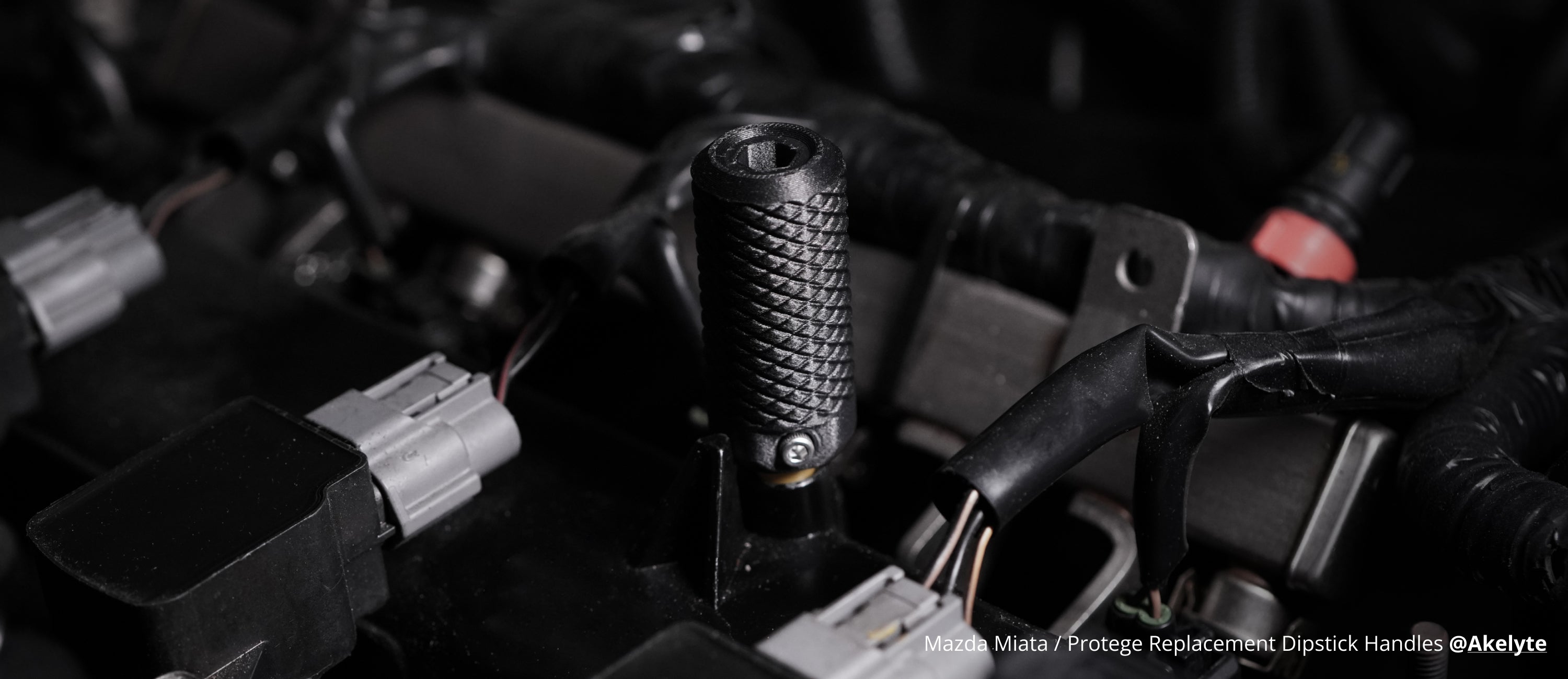
Bambu PET-CF is a blend of tough PET and carbon fiber. Carbon fiber improves hardness and mechanical strength, while still help maintain the low warping and shrinkage of ordinary PET. Bambu PET-CF has excellent high temperature resistance and a soft glow appearance. Its excellent strength, heat resistance, dimensional stability and low moisture absorption make Bambu PET-CF an ideal choice for load-bearing structures or prints used in high temperature and humid environments.


Low moisture absorption
In saturated water absorption conditions, the strength and stiffness of PET-CF have small losses, making it suitable for prints used in high humidity environments.
Normal PA-CF
Loading Weight: 1 kg

Bambu PET-CF
Loading Weight: 1 kg

The test models have a span of 220 mm and a thickness of 3 mm in unloaded state.
High dimensional stability
Due to the creep and warping resistance of PET-CF, prints can achieve excellent matching accuracy.

Specimens size (L*W*H): 240*8*15 mm³
Infill density: 60%
Exceptional thermal resistance

• Specimen size (L*W*H): 95*10*4 mm³
• Test conditions: Specimens were put in an oven at 70 °C and 150 °C respectively for 0.5 hour.
• As a crystalline material, PLA will significantly deform only after the temperature exceeds its melting point (around 155°C).
Printing setup
0.6 mm Hardened Steel Nozzle (Recommended)
0.4 mm / 0.8 mm Hardened Steel Nozzle (Capable)
Enclosed printer (Recommended)
Open frame printer (Capable)*
AMS NOT compatible
*Layer bonding of some prints may become low due to overcooling.

Accessory Compatibility
| Recommended | Not Recommended | |
| Build Plate |
Cool Plate SuperTack, Smooth PEI Plate, Textured PEI Plate
|
/
|
| Hotend |
Hotend with Hardened Steel 0.4mm / 0.6mm (recommended) / 0.8 mm
|
Hotend with Stainless Steel Nozzle All Size
|
| Glue | Glue Stick | Bambu Liquid Glue |
Frequently Asked Questions
What is the difference between PET-CF and PETG-CF?
The primary difference between PET-CF and PETG-CF lies in their base material. PETG-CF is a reinforced material made by adding carbon fiber to glycol-modified polyethylene terephthalate (PETG), while PET-CF is to polyethylene terephthalate (PET). The key difference 'G' in PETG stands for glycol. PETG is a glycol-modified version of PET that contains small amounts of glycol as a co-monomer. The addition of glycol to PETG reduces its crystallinity and makes it more transparent. However, it also reduces its strength and stiffness.
The difference in application between PETG-CF and PET-CF?
PETG-CF is a versatile basic material that is suitable for printing everyday items, such as bent, folded, and movable parts, due to its excellent toughness and ease of printing. PET-CF, in contrast, contains a greater amount of carbon fiber and is significantly stronger and more temperature resistant compared to PETG-CF. PET-CF is a professional-grade engineering material that is suitable for use in more complex and demanding environments.
What is PET-CF used for?
Due to its dimensional stability and lower water absorption rate, PET-CF is a better choice than nylon for printing functional parts used in high humidity environments. Also, its high-temperature resistance and low warping make it suitable for printing mechanical assembly parts, such as automotive accessories and fixtures.
Parameters Comparison
Learn more different filaments comparison on Bambu Filament Guide >>
| PET-CF | PAHT-CF | |
| Price/1kg | £78.99 | £87.99 |
| Composition | PET, carbon fiber | PA 12 and other long-chain PA, carbon fiber |
| Hotend Compatibility | Hardened Steel 0.6 (recommended), 0.4, 0.8 mm | |
| Build Plate Compatibility | Engineering Plate, High Temperature Plate, Textured PEI Plate | |
| Glue | Glue Stick / Liquid Glue | Glue Stick |
| AMS Compatibility | NO | Yes |
| Print Speed | < 100 mm/s | < 100 mm/s |
| Toughness (Impact Strength - XY) | 36.0 kJ/m² | 57.5 kJ/m² |
| Strength (Bending Strength - XY) | 131 MPa | 125 MPa |
| Stiffness (Bending Modulus - XY) | 5320 MPa | 4230 MPa |
| Layer Adhesion (Impact Strength - Z) | 4.5 kJ/m² | 13.3 kJ/m² |
| Heat Resistant(HDT, 0.45 MPa) | 205 °C | 194 °C |
| Saturated Water Absorption Rate / % (25 °C,55% RH) | 0.37 | 0.88 |
| Recommended Printing Settings | |
| Drying Settings (Blast Drying Oven) | 80 °C,8 - 12 h |
| Printing and Keeping Container's Humidity | < 20% RH (Sealed,with Desiccant) |
| Nozzle Temperature | 260 - 290 °C |
| Bed Temperature (with Glue) | 80 - 100 °C |
| Printing Speed | < 100 mm/s |
| Physical Properties | |
| Density | 1.29 g/cm³ |
| Vicat Softening Temperature | 226 °C |
| Heat Deflection Temperature | 205 °C |
| Melting Temperature | 250 °C |
| Melt Index | 25.3 ± 2.5 g/10 min |
| Mechanical Properties | |
| Tensile Strength | 74 ± 6 MPa |
| Breaking Elongation Rate | 4.5 ± 1.2 % |
| Bending Modulus | 5320 ± 270 MPa |
| Bending Strength | 131 ± 6 MPa |
| Impact Strength | 36.0 ± 2.7 kJ/m² |
Downloads

Printing Tips
• Drying conditions: 80℃ for 8 hrs. PET-CF is highly sensitive to humidity. To achieve optimal printing performance, it is recommended further drying before use and after storage. For more details, please refer to:Filament drying instructions on WIKI.
• To prevent the material from absorbing moisture, it is recommended to use an airtight storage container with desiccant during printing. For more details, please refer to:Printing tips for Engineering materials on WIKI.